Quasimodo’s deaf hearing and sentencing at the Châtelet
The Hunchback of Notre DameQuasimodo’s deaf hearing and sentencing at the Châtelet exposes a justice system in which official procedure proceeds even when its participants cannot understand one another. Quasimodo, restrained and surrounded by armed guards, faces an auditor who conceals his own deafness; their failed exchange is treated not as a reason to pause the examination but as grounds for a harsher punishment. The scene’s central reversal comes when a clerk attempts to help Quasimodo by explaining his disability, only for the auditor to mistake the unheard plea for information that warrants an additional hour at the pillory.
The hearing and its setting
The hearing unfolds against a background of divided authority in fifteenth-century Paris. The city consisted of three distinct parts: the City on the island, the University on the left bank of the Seine, and the Town on the right bank. Each had its own character and institutions, while jurisdiction was divided among the bishop, the provost of the merchants, and the Rector of the University; above them stood the provost of Paris, a royal rather than municipal official. The City had Notre-Dame, the Town had the Louvre and the Hôtel de Ville, and the University had the Sorbonne.
This fragmentation could shape the path from accusation to punishment. Offences involving scholars on the University’s left bank were tried in courts on the island and punished on the right bank at Montfaucon, unless the Rector intervened under the scholars’ privileges. Those privileges, the narrator notes, had often been won through revolt and mutiny. Quasimodo’s hearing is therefore presented within a larger world where overlapping jurisdictions and privileges coexist with swift, forceful punishment. The immediate authority in his case is the provost’s court, whose proceeding moves rapidly from examination to sentence.
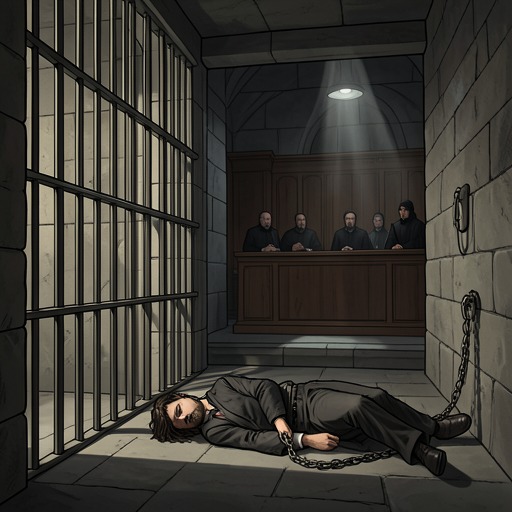
Quasimodo arrives bound and under close guard, with a squad of policemen and the watch’s chevalier around him. The account stresses the mismatch between this show of force and what the scene supplies as justification for it: apart from his deformity, Quasimodo is gloomy, quiet, and calm. His single eye occasionally turns toward his bonds with anger, while onlookers point him out in derision. The formal apparatus of accusation thus surrounds a prisoner whose conduct, as described at the outset, is not itself presented as threatening.
An examination distorted by deafness
The auditor, Master Florian, studies the written complaint before questioning Quasimodo. The document gives him the charges and lets him prepare answers in advance, a practice he uses to keep his deafness from becoming apparent. He has become skilled at making the examination seem controlled, although the narrator notes that others interpret his occasional incoherence either as profundity or as foolishness. Rather than expose the limitation, the hearing turns concealment into part of the magistrate’s performance.
Before beginning, Master Florian adopts a pose meant to suggest majesty and impartiality, closing his eyes and raising his head. The narrator pointedly describes him as deaf and blind in that posture. The first questions do not produce answers that the auditor can properly understand. When he proceeds to list charges of nocturnal disturbance, violence against a woman, and resistance to the king’s archers, he assumes Quasimodo has already responded and asks the clerk whether those replies have been recorded. The question provokes laughter among the clerk and spectators. The two deaf men notice the reaction without understanding its cause: Quasimodo shrugs, and Master Florian reads that gesture as an insulting answer.
The confusion continues when the provost enters. Master Florian redirects his speech toward the new arrival and asks for punishment for an offence against the court. The provost then questions Quasimodo, but Quasimodo mistakes the question for a request for his name and answers accordingly. When asked about his age, he answers that he thinks he will be twenty on Saint Martin’s day. The exchange gives the provost further reason to believe he is being mocked, although the audience has seen how failures of hearing have shaped the conversation from the beginning.
Sentence and failed mitigation
The provost orders that Quasimodo be taken to the pillory of the Grève, flogged, and turned there for an hour. He also orders the judgment proclaimed throughout the seven castellanies of the viscomty of Paris, with four sworn trumpeters. The clerk promptly writes out the sentence, and the narrative contrasts this direct procedure with the more elaborate legal technicalities that would be introduced later. At this point, punishment follows quickly and explicitly from the authority’s interpretation of the exchange.
As Master Florian prepares to sign the sentence, the clerk feels pity for Quasimodo and tries to obtain a mitigation. He approaches the auditor and explains that the prisoner is deaf, hoping that this shared condition will awaken sympathy. But Master Florian does not hear the explanation. He nevertheless wants to appear to have heard it, and responds by adding an hour to the pillory punishment. He then signs the sentence as modified. The attempted appeal for leniency has therefore produced the opposite result—not through a deliberate decision to punish deafness, but through the auditor’s concealment of his own impairment and his insistence on sustaining the appearance of comprehension.
Institutional irony and consequence
The episode makes the examination’s failure more than a private misunderstanding. The court continues to exercise its authority even though the auditor has not reliably heard the accused, the accused cannot follow the questions, and the clerk’s attempt to clarify the situation is itself unheard. Each participant acts within the forms of the proceeding, but those forms do not ensure that testimony has been understood. The sentence is recorded and signed all the same.
The narration sharpens this criticism through irony. Master Florian’s prepared use of the complaint is compared to a guide that helps a blind person, and his efforts to hide deafness become an obstacle to the very judgment he is meant to conduct. His pose of impartiality, with eyes half closed, is made inseparable from the scene’s image of an official who cannot hear what matters. The result is not a reasoned adjustment to Quasimodo’s circumstances but an additional hour of punishment, imposed because the judge preserves appearances rather than admitting what he cannot hear.
The hearing also sits within the book’s broader depiction of divided medieval justice. Paris’s jurisdictions and special privileges could complicate who tried an offence and where a sentence was carried out, yet the account of Quasimodo’s case emphasizes how swiftly a local authority can impose punishment. His disability becomes consequential not because the court adapts its procedure to it, but because the participants’ inability to communicate is absorbed into a process that keeps moving. The clerk’s compassion briefly offers a possibility of mitigation; the final signature closes it, leaving Quasimodo condemned to the pillory under a sentence made harsher by the very explanation meant to help him.